Queensland-based aerospace companies Gilmour Space Technologies and Hypersonix Launch Systems have signed an agreement to…
Royal Navy plans ‘loyal wingman’ carrier tests through Project Vanquish
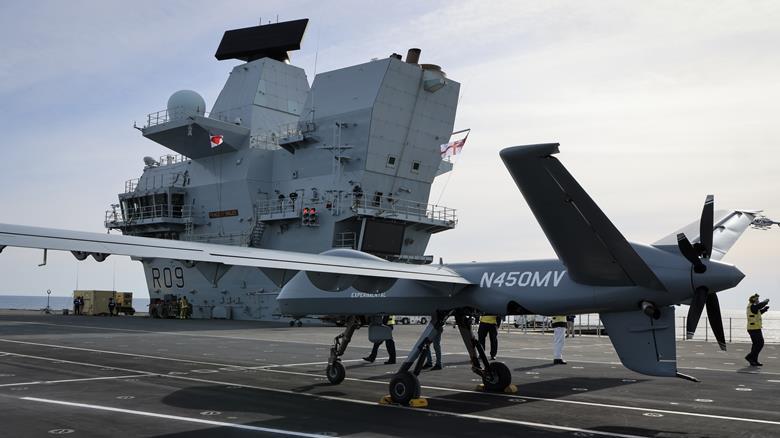
The UK’s Royal Navy has issued a Request for Tenders, closing on 14 November, for a technical demonstration at sea of an attritable, Tier 2 Fixed Wing Short Take Off and Landing Autonomous Collaborative Platform (FW STOL ACP). Delivered under Project Vanquish, this will be part of the route to the UK Royal Navy’s Hybrid Air Wing; nominal target date is the end of 2026, with options for delivery within an 18-month window from the target date also considered.
A total of £12 million ($24.5 million) has been allocated for the Project Vanquish effort. The RN says the air vehicle must be able to embark and operate autonomously from a Queen Elizabeth Class (QEC) Aircraft Carrier and is to be jet turbine-powered and capable of high subsonic speeds. It should be able to launch and recover to QEC without Catapults or Arrested Recovery Systems and with a credible payload and endurance.
There must be an exploitation pathway to the delivery of a wide range of maritime mission sets in support of UK Carrier Strike in due course (ISR/Strike/Air-Air Refuelling), to compliment the UK Armed Forces’ F-35B Lightning IIs, as part of QEC and its Carrier Air Wing.
The outcome of this RFI will inform the capability of the UK industrial base in support this requirement. Successful completion of a technical demonstration will inform future capability development and procurement options, says the UK Ministry of Defence (UK MoD). This RFI is separate to, but coherent with, existing CSAEW RFI’s dated 9th & 22nd Apr 2025 and will aid understanding of cross cutting technologies which may assist both lines of development. It must be aligned with the principles of Maritime Aviation Transformation (MATX) and build on previous trials and demonstrations of ACPs from QEC.
Last month the US Navy awarded contracts to four companies to build ACPs – the US refers to them as Collaborative Combat Aircraft, CCAs – to complement its planned 6th generation F/A-XX fighter. Anduril Industries, Boeing, General Atomics and Northrop Grumman have been down-selected with Lockheed Martin awarded a separate contract to build a common control system based on its MDCX autonomy platform for the CCA.
Industry respondents to the US Navy’s CCA program have declined to comment, though Anduril has stated it will build an aircraft designed specifically for the US Navy’s needs.
It’s not clear whether or not Royal Navy autonomous aircraft will be compatible with US Navy autonomous aircraft, existing and planned, such as the MQ-25A Stingray tanker. Nor is it clear whether RN aircraft will be compatible in any way with RAAF and USAF aircraft such as the Australian MQ-28A Ghost Bat or the YFQ-42A and -44A CCAs currently being tested by the USAF.
British publication Flight International reports that the RN has previously trialled various ACP-type systems from its carriers, including flying a General Atomics Aeronautical Systems Mojave air vehicle from HMS Prince of Wales in 2023. A tender notice is expected early next year.
Related Posts