Queensland-based aerospace companies Gilmour Space Technologies and Hypersonix Launch Systems have signed an agreement to…
Boeing unveils upgraded MQ-28 Ghost Bat at ILA Berlin
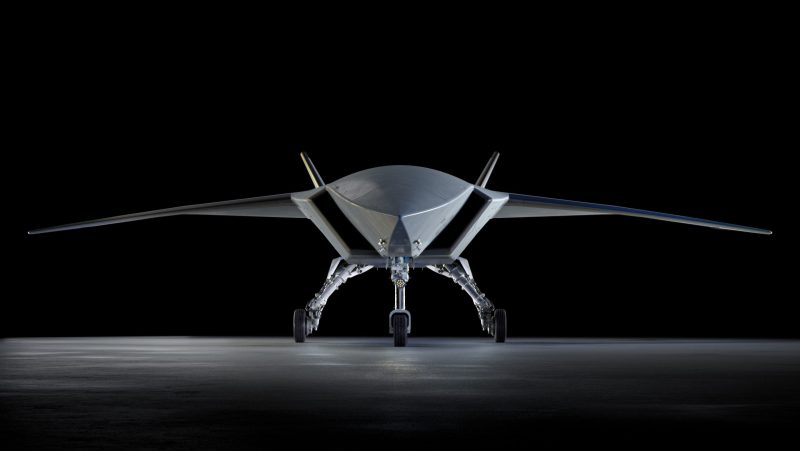
Boeing has unveiled the extended combat capabilities of the Australian-developed MQ-28A Ghost Bat at the ILA Berlin Air Show in Germany. The enhancements, bringing the Ghost Bat to Block III configuration, include an increased wingspan which allows the Collaborative Combat Aircraft (CCA) to carry an additional 2,000 pounds of fuel, stores, and mission payloads. It can also be provisioned to carry two AIM-120 AMRAAM missiles or four GBU-39 Small Diameter Bombs (SDBs) internally and so more stealthily.
The wing is more than 25% percent larger while Beyond Line of Sight (BLOS) communications capabilities increase command and control flexibility, said Boeing in a media release. Maximum take-off weight is now increased from 10,000lb to 12,000lb while the useful load has increased to more than 4,500lb.
“That additional capacity gives operators freedom to balance payload and endurance to configure for the mission at hand, whether that means carrying extra fuel for longer-range operations, increasing weapons carriage, or any combination of both,” said Glen Ferguson, MQ-28 global program director.
“These features, developed in partnership with the Royal Australian Air Force, will be progressively released to the fleet through a spiral upgrade program, and are available to interested allied countries.”
Other new MQ-28 capabilities include: significant software development upgrades compliant with US Government Reference Architecture; an upgraded modular, missionised nose, providing enhanced payload configuration options and supporting the insertion of third-party capability; the introduction of BLOS communication links enabling the MQ-28A custodian to now operate from a crewed aircraft, ground station or Naval vessel at unlimited standoff distances; and two internal weapons stations, each with capacity for one AMRAAM missile or two SDBs, along with provision for three external weapons stations.
“The advanced maturity of the MQ-28 systems is what allows us to continually adapt to the changing operational environment and minimise the risk as we transition to operations,” said Amy List, vice president and managing director of Brisbane-based Boeing Defence Australia.
“Combined with the MQ-28’s confirmed low observability characteristics, and survivability upgrades, these capability enhancements support more flexible mission concepts and further allow Defence customers to distribute operational risk.”
Boeing also announced at ILA two further additions to its German MQ-28A industry team: along with strategic partner Rheinmetall, the company has now signed teaming agreements with Diehl Defence and Rohde & Schwarz. Diehl Defence will explore weapons integration and technical support, including the integration of German weapons into the MQ-28 and contributing software elements that support air combat chains.
Rohde & Schwarz will contribute to the integration of mission and communications systems with other Bundeswehr (German Army) command and weapon systems, ensuring tailored adaptations to meet German national requirements, and providing operational, maintenance, and logistical support for these systems.
Related Posts