The US Air Force Research Laboratory (AFRL) and Anduril Industries have demonstrated modularity on a…
Royal Navy develops three autonomous testbeds for ASW operations

The UK Royal Navy’s Anti-Submarine Warfare (ASW) Spearhead program has rapidly developed three autonomous testbed platforms, CETUS, PROTEUS, and SCYLLA, to enhance the service’s ASW capabilities. A collaboration between the Royal Navy, defence industry, and research organisations the ASW Spearhead program has rapidly delivered the platforms to strengthen Britain’s naval capabilities and support AUKUS Pillar II which lists Undersea Capabilities and AI and Autonomy as Strategic Priorities.
The Spearhead program, says the UK Ministry of Defence (UK MoD), demonstrates how innovative governance and joint working can accelerate defence technology from concept to capability. In seven years, this £400 million ($816 million) initiative has produced three testbeds:
- CETUS: One of the largest autonomous underwater vehicles (20 tonnes, 12 metres) began trials with the Royal Navy in February 2025
- PROTEUS: a 3-tonne autonomous rotary platform is demonstrating rapid concept-to-hardware development for dangerous missions and future maritime surveillance
- SCYLLA: Submarine-launched autonomous system is conducting ASTUTE-class integration trials, supporting AUKUS seabed warfare objectives
The program’s success stems from a 7-step governance framework that prioritised speed without compromising safety. This approach, championed by UK Defence Innovation (UKDI – formerly DASA), enabled rapid development while maintaining rigorous operational standards, says the UK MOD.
Multi-year funding provided industry partners with the confidence to innovate and covered all development activities, ensuring that demonstrators could progress without traditional handover delays. The Defence Science Technology Laboratory (Dstl) provided technical support throughout the program.
Developed through partnership between the Royal Navy, Strategic Defence Acquisition, and Plymouth-based MSubs Ltd, CETUS is Britain’s largest autonomous submarine and represents a shift in naval autonomous operations. Originally funded through a Dstl and Defence and Security Accelerator (DASA) project, through the Submarine Delivery Agency (SDA) MSubs delivered the £15.4 million, 12-metre autonomous underwater vehicle in November 2022. At 25 tonnes with full payload, the CETUS Extra Large Uncrewed Underwater Vehicle (XLUUV – named XV Excalibur in May 2025) is one of the most complex uncrewed submersibles used by any navy to date, says the UK MoD.
The PROTEUS Uncrewed Aerial System (UAS) demonstrator is a 3-tonne autonomous rotary platform, delivered by Leonardo, and serves as a testbed for autonomy and mission modularity, initially focusing on sonobuoy deployment and communications relay missions that are both critical to anti-submarine warfare operations. The PROTEUS program showcases the program’s agile approach, says the UK MoD, accelerating from initial requirements to hardware delivery within three years through innovative acquisition approaches.
PROTEUS is designed to address critical dangerous missions while reducing reliance on expensive crewed helicopter operations, delivering significant cost savings and risk reduction. Future capabilities will expand beyond sonobuoy operations to include logistics support, search and rescue coordination, and maritime surveillance missions.
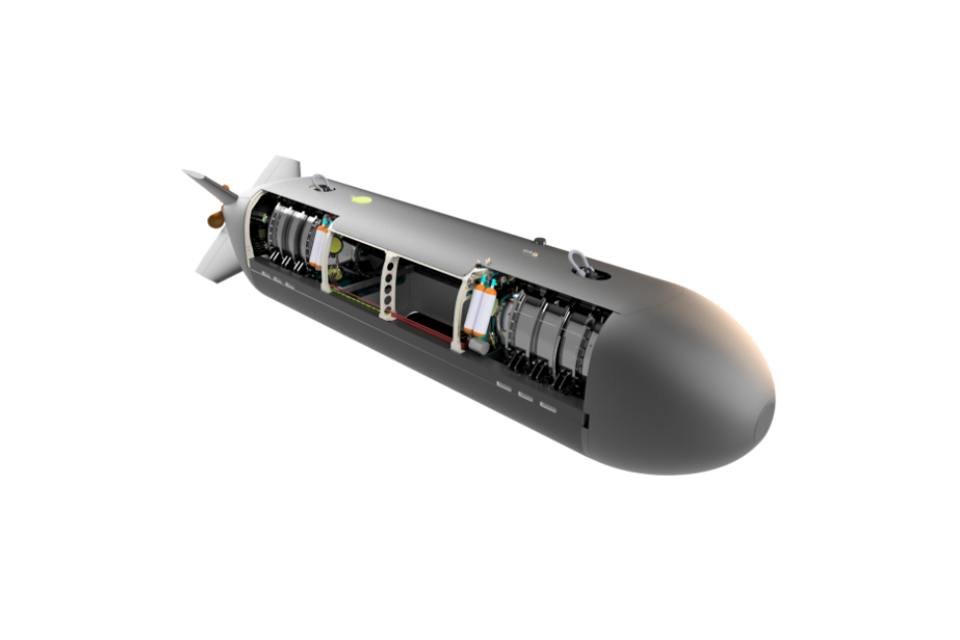
Project SCYLLA is an autonomous torpedo tube launch and recovery system developed through Spearhead. The vehicle is designed to be launched then autonomously conduct missions and recover itself back into a submarine torpedo tube, enhancing submarine capabilities without requiring platform modifications.

SCYLLA features a modular mid-section, which allows mission-specific payload configurations for diverse operational requirements. Trials on ASTUTE-class submarines began in 2024, with Initial Operating Capability planned for 2026-27. The platform supports AUKUS Pillar 2 objectives by providing submarines with deployable autonomous vehicles capable of seabed warfare, intelligence operations, and covert surveillance missions.
“SCYLLA delivers a paradigm shift in ASW capabilities, the most significant since the introduction of Tomahawk,” said CDR Chris Hill, ASW Spearhead Program Director. “Working with AUKUS partners development is underway on a range of Seabed Warfare and ISR payloads for this expeditionary capability.”
Related Posts