Queensland-based aerospace companies Gilmour Space Technologies and Hypersonix Launch Systems have signed an agreement to…
MILLIBEAM reveals RAKURAI C-UAS capability
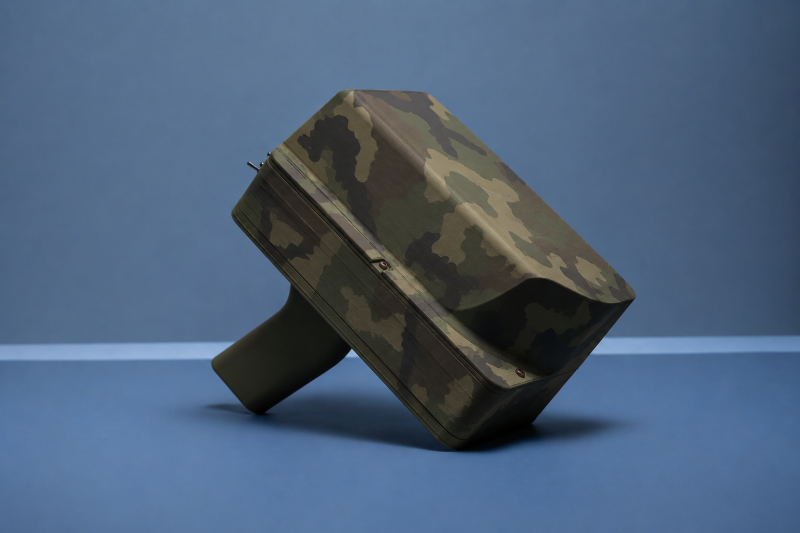
Sydney based startup MILLIBEAM has revealed RAKURAI, a sovereign Counter-Uncrewed Aerial System (C-UAS) built on proprietary Radio Frequency (RF) architecture that the company says is a world-first. RAKURAI has recently achieved TRL 5 in preparation for field testing.
RAKURAI overcomes the weight, battery life, and narrow frequency coverage that prevent handheld C-UAS jammers from scaling to every soldier and first responder. Its launch follows $4.6 million in federal government grants to support development of the underlying RF architecture.
RAKURAI addresses the challenges set out in Project LAND156 and the broader 2026 National Defence Strategy, which prioritise sovereign C-UAS capability to protect the ADF and domestic critical infrastructure against evolving drone threats, says MILLIBEAM.
Radio frequency technology has not fundamentally changed in a century. Because these legacy systems rely on off-the-shelf catalogue components, they are capped in weight, power, range and band coverage, the company says, leaving a widening gap as drone threats evolve faster than conventional counter-measures can keep up.
“Every counter-drone system on the market today is built by bolting together off-the-shelf parts – and that ceiling is exactly what’s letting drone threats outpace our defences,” said Mike Nicholls, a partner at technology funder Main Sequence. “To deliver the performance needed to put this capability in the hands of individual warfighters and security teams, the MILLIBEAM team had to design and match the entire RF architecture from the ground up, including the chips and the antennas.”
MILLIBEAM says it has rebuilt RF and millimetre-wave capability from the chip up, here in Australia. Rather than assembling catalogue parts, the company co-designs four subsystems – antennas, RF front-end, power electronics and signal generation – as a single, integrated system. It is this chip-level design that allows RAKURAI to overcome the limitations of catalogue-built systems, says MILLIBEAM, transmitting simultaneously across widely separated frequency bands to hold the link where single-band systems are jammed, degraded or defeated.
“For a century, the world has built more on top of legacy RF communications networks without ever rebuilding the foundation itself,” said Venkata Gutta, Founder and CEO, MILLIBEAM. “Designing from the chip up, here in Australia, is how we field sovereign capability at the speed and scale the National Defence Strategy demands.”
The reveal follows a series of grants awarded to MILLIBEAM: $2.6 million under the Federal Government’s Industry Growth Program, which directly supports the National Reconstruction Fund’s focus on building Australia’s future manufacturing capability; and $2 million under the Supply Chain Resilience Initiative to support the development and commercialisation of next-generation beamforming semiconductor chipsets for millimeter-wave 5G. Both support development of the underlying technology that powers RAKURAI and other applications.
Related Posts