Queensland-based aerospace companies Gilmour Space Technologies and Hypersonix Launch Systems have signed an agreement to…

IN DETAIL: Astroscale and HEO tackle space servicing challenge
Astroscale Holdings, a Japanese leader in the emergent science of satellite servicing, or On-Orbit Servicing (OOS), has signed a three-year MoU with Australian company High Earth Robotics Pty Limited (HEO), an acknowledged market leader in non-earth imaging and space-based Space Domain Awareness (SDA). Basically, HEO can image a satellite and Astroscale can then track, manage and service it.
Gregor Ferguson
The emerging science of Rendezvous and Proximity Operations (RPO) doesn’t yet allow for satellites to be refuelled in orbit – though that step is coming – but Astroscale has built its reputation doing Inspections and Debris Removal. These operations all require an RPO capability, says Chris Blackerby, the company’s Chief Operating Officer, and that starts with a good imaging system.
“HEO has great observation and sensing capabilities,” he says. Hence Astroscale’s relationship with HEO, which was cemented at IAC 25 in Sydney: the two companies aim to enhance the inspection and characterization of space objects, develop catalogues of candidate debris clients, and refine operational concepts to support safe and efficient on-orbit servicing missions for allied nations.
“By introducing On-Orbit Servicing (OOS) as a new value proposition to what was once a value chain based on a throwaway culture, we are working to create a circular economy in space” according to Nobu Okada, Astroscale’s founder and CEO.
While HEO is still a relatively small Australian start-up, Astroscale Holdings Inc. is a Japanese public company employing some 650 personnel, and has offices in the United States, United Kingdom, France and Israel. In fact, it is recognised as a domestic company in each of these countries, which allows it to win local and regional government contracts.
In the last financial year, the company achieved revenue of JPY6.1 billion (approximately $61 million), but recorded an overall operating loss of JPY18.7 billion (about $190 million). However, its backlog at the end of the first quarter of the current financial year increased to JPY43.7 billion ($440 million), 1.5 times that of FY2025, and it is projecting more than JPY75 billion in revenue over the next three financial years from civil and military projects either contracted or under proposal.
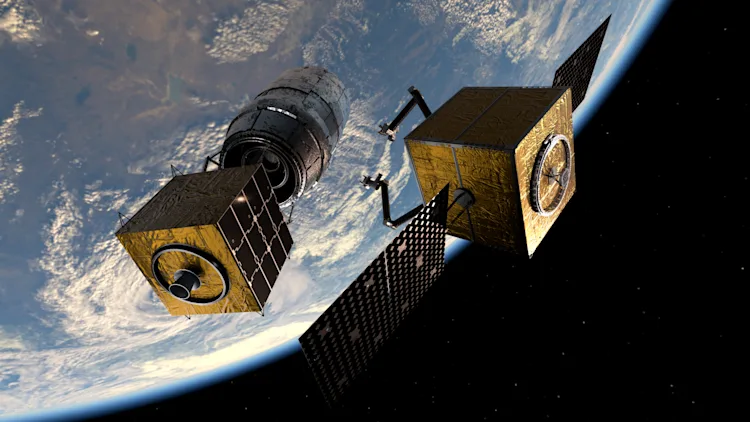
At present, Astroscale works primarily in the Geosynchronous (GEO) orbital band where up to 590 large satellites, some of them weighing tonnes, relay communications and TV signals, or conduct surveillance operations. The life of these satellites is typically 15 years or so: they either run out of propellant, shift too far out of their orbits, or (more rarely) run out of bandwidth. None of this means the satellites themselves are useless, and Astroscale is making a business case for servicing them.
The business case is actually quite simple, according to Blackerby: economic calculations show it is only a fraction of the cost to the operator to move the satellite back into the correct orbital plane, compared with developing and launching a new one. The INMARSAT I-6 F1, for example, has a design life of about 15 years and a total cost of about $1 billion for two satellites, making an annual cost of between $30 and $40 million per year, per satellite. Repositioning an errant satellite is attractive to the customer and profitable for the small number of companies worldwide that can do such a thing, says Blackerby.
The schedule for replacing a satellite is also not flexible – replacing something currently in orbit could take years.
Importantly, servicing a satellite instead of building and launching a new one requires cash-flow rather than capital expenditure and can save a business a lot of capital. A service-based business model charges when the service is being delivered: it might be three years at $10-$15 million a year, and for that the operator might get another 15 years of service. That said, it’s commercial customers who are expected to pay service fees; defence and civil (governmental or space agency-type customers) tend still to make milestone payments leading up to the sale of a satellite or the completion of a project.
Any failure to dispose of the satellite at the end of its life could lead to regulatory sanctions. Quite a few satellites are moved into ‘safe’ orbits when they reach the ends of their useful lives, but quite a few which have run out of propellant are also just left with a slowly decaying orbit and no way of modifying it. Hence Astroscale’s involvement in debris removal – essentially, removing old satellites or pieces of ‘space junk’ that could damage or kill a satellite or manned space craft.
Astroscale estimates about 20 to 30 GEO satellites reach retirement age each year, with an estimated market over the decade from 2023 to 2033 worth around US$18.2 billion. Many of the operators of these satellites have started to indicate genuine interest in OOS as a means of extending a satellite’s life.
The company has set out four phases in its business plan: the first is demonstration of RPO, which it has done. The second, which will run from about 2025 to 2030, is to make companies aware of the current and future capabilities of OOS. The third phase, from 2030 to about 2035, is (hopefully) widespread adoption of OOS; and the final phase, beginning in 205, will see OOS as a standard procedure, with standardised industry procedures and the establishment of an industry-wide body of infrastructure.
The company has demonstrated it can dock with a satellite in GEO orbit and reposition it, says Blackerby. If the satellite’s position and orbit are known, if communications exist with the satellite and, even better, it has docking interfaces and markers, RPO is much simpler. However, Astroscale believes it is the only company in the world that has demonstrated RPO capabilities for non-cooperative objects in space. Non-cooperative in this context means old and very rough orbit information, no control over the satellite’s attitude or orbit, no working communications and no docking interfaces and markers.
The next technical stage is refuelling a satellite – this will add years to the lives of some satellites – while uploading an updated software load could give a satellite a new lease on life. We’re not there yet, says Blackerby, but aren’t that far away. And the next stage after that is the development of a robotic arm that can manipulate satellites and enable more complex refuelling or service operations.
Astroscale has three customer groups and four mission definitions. Customer groups are easy: Civil (non-defence government and quasi-government organisations such as space agencies); defence; and commercial operators. The four mission definitions are: ISSA for In-Situ Space Situational Awareness; LEX is Life Extension and Refuelling; EOL stands for End-of Life service; and ADR means Active Debris Removal.
The company has flown two test missions, Blackerby says, and demonstrated through its ELSA-d (launched in 2021) and ADRAS-J (2024) missions that it can dock successfully with a satellite and remove debris from an increasingly crowded orbital band. Astroscale spacecraft have as a result been selected for pioneering missions with JAXA, the US Space Force, the European Space Agency, the UK Space Agency, and Eutelsat OneWeb, the company says.
Astroscale has a number of future civil missions planned or under development: ELSA-M, which will launch in 2027; COSMIC in 2029; ISSA-J1 in 2027/28, ADRAS-J2 in 2028, and so on. REFLEX-J, which will launch in 2030,will be the first refuelling mission, for JAXA, the Japanese aerospace agency. It also has five defence-related missions planned: the first, APS-R, will be a LEX mission and will launch in 2027. Launch dates for a number of the others have not been disclosed. The short- to medium-term growth driver will probably be defence demand.
The next step is to persuade satellite manufacturers and operators to add a magnetic ‘docking plate’ to their designs so that companies like Astroscale can manipulate them, reposition them and, eventually, retire them safely and more easily. In fact, a number of satellite manufacturers have already ordered them. Such a plate could weigh anything from 200g to 1kg. The cost per satellite should be relatively low, says Blackerby; the cost per launch will be higher, naturally (though the cost of launching 1kg of payload into space has fallen dramatically in recent years), but more than offset by the ability to extend the satellite’s service life efficiently and cost-effectively.
The company is also looking at the Low Earth Orbit (LEO) band, from 200km out to about 2,000km above the earth. This band has seen near-ten-fold growth in the number of objects in orbit, says Blackerby. For example, just one operator, OneWeb, plans to have 600 satellites in LEO, increasing the risks faced by launch agencies; Astroscale predicts that around 20,000 satellites will have been launched by 2030, the majority in LEO.
Even more worryingly, the company believes the number of trackable objects in space that are less than 10cm in size reached 44,700 last year, a growing number of them in LEO. Some 2,500 of these were defunct satellites and more than 2,000 were the upper stages of rockets – and the number of trackable objects will at least double by 2030. The number of monthly near-misses between satellites and debris has grown almost exponentially in the past five years. Which is why Astroscale focusses so much on Space Domain Awareness (SDA).
In a flurry of activity between June and September last year the United Nations and G7 governments all agreed on the importance of space debris mitigation and remediation; the ITU Space Sustainability Forum in September last year called explicitly for ‘the development of new technologies of in-orbit servicing of space radio communication service spacecraft, including active space debris removal.’
Development of the OOS market over the long term is supported by these and other regulatory and institutional frameworks. In the USA, for example, the ‘5-year rule’ now requires satellites launched after September 2024 to deorbit within five years after the end of operations. In Europe, the Zero Debris Charter has been announced, clarifying that no debris should be left after mission completion from 2030 onward. Demand for debris removal will become more active in the 2030s as a result.
And hence also the relationship between Astroscale and HEO Robotics. The Australian company is at the core of this effort, powering satellite inspection solutions that contribute directly to allied SDA strategies.
“Through this partnership, we are strengthening the connection between monitoring and managing orbital risks, advancing essential SDA capabilities, and supporting mission success across all orbits,” says Mike Lindsay, CTO at Astroscale. “A sustainable space ecosystem requires coordinated data and action, and we’re proud to deepen our collaboration with HEO to help make it a reality.”
“The market is currently in its early stage, and we expect OOS to become a routine service by 2030 and an indispensable part of space infrastructure by 2035,” says Nobu Okada. “In fact, we believe that this pace is necessary to realize the sustainable use of space.”
Related Posts