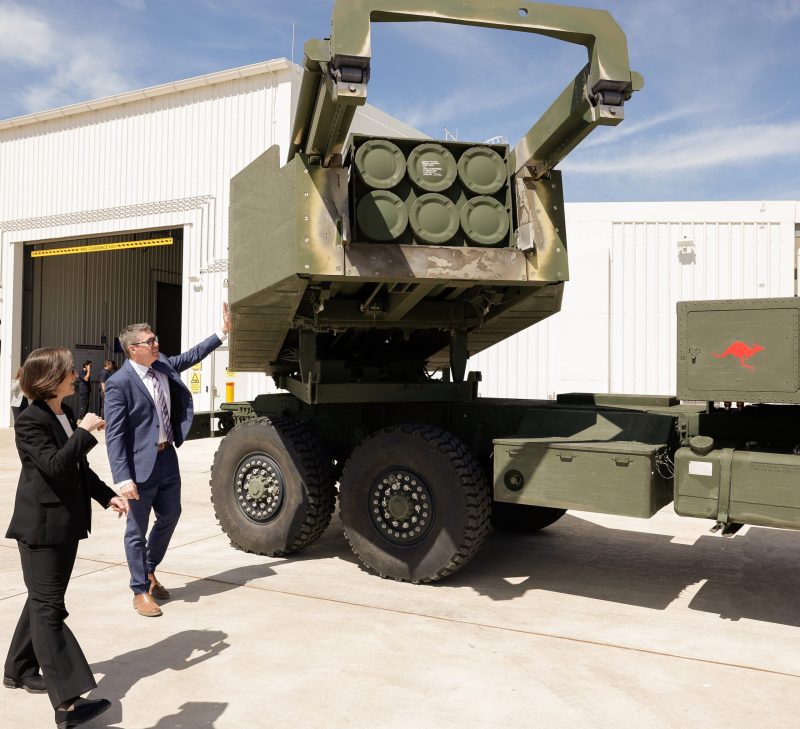
The Australian government has approved Republic of Korean company Hanwha’s long-standing application to increase its…

CAE wins $300 million contract from RAAF for airborne training
The Australian Department of Defence has awarded Sydney-based CAE Australia a $300 million contract for the Future Air Mission Training System (F-AMTS), under Project AIR5428 Ph.3. The F-AMTS, which is designed to increase Defence’s aircrew training capacity by up to 70 %, will be delivered to RAAF Base East Sale, east of Melbourne, and includes a new facility for the Air Mission Training School (AMTS).
The F-AMTS will use a mix of advanced simulation, modern courseware and real-world training to prepare crews for advanced Electronic Warfare (EW) and Intelligence, Surveillance and Reconnaissance (ISR) platforms such as the MC-55A Peregrine and MQ-4C Triton.
The new training system will support the development of critical non-pilot roles including Airborne Electronics Analysts, Operations Officers, Air Mobility Officers, Air Traffic Controllers, Air Battle Managers, Maritime Patrol and Response Officers, Weapon Systems Officers, and Electronic Warfare Officers.
The F-AMTS spans an initial 10-year performance period, with the first students expected to graduate in 2028. Capability delivery will commence at RAAF Base East Sale from 2026, says CAE’s Montreal-based Canadian parent.
It will upgrade training systems that support initial training for personnel operating advanced Royal Australian Air Force (RAAF) air and ground-based capabilities. Featuring an integrated learning environment, the system will combine classroom instruction, advanced simulation technologies, and airborne training to deliver an immersive, world-class training experience.
The F-AMTS represents a transformation in how the RAAF will train its mission aircrew, says CAE Australia, adding that it is working with leading Australian industry training, simulation and sustainment organisations including Nova Systems, Adacel, DXC Technology, Milskil, MMCLD, Airflite, and Seeing Machines.
“Achieving mission readiness for today’s rapidly evolving defence and security landscape requires a training partner who deeply understands the complexity and challenges faced in operations,” explained France Hébert, CAE’s President Defense & Security – Canada and International. “This is more than a shift in how training is delivered – it is a strategic investment in Australia’s national resilience and defence capability. By delivering a world-class, scalable, and cost-effective training solution, CAE will equip aviators with the skills, confidence, and agility to meet operational demands effectively.”
Related Posts