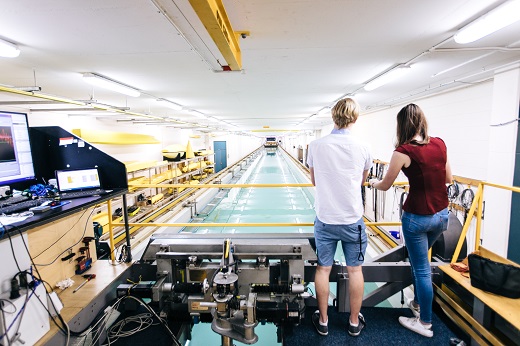
Defence and the University of Tasmania’s Australian Maritime College (AMC) have opened a secure research…

USAF demonstrates MUM-T with F-15 and F-16 and Kratos XQ-58A
The US Air Force says it has demonstrated a major leap in Man-Machine Teaming (MUM-T), flying Autonomous Collaborative Platforms (ACPs) alongside crewed fighter aircraft during a training event at Eglin Air Force Base, Florida. Pilots operating an F-16C Fighting Falcon and an F-15E Strike Eagle each controlled two Kratos XQ-58A Valkyrie aircraft in an air combat training scenario, showcasing real-time integration between manned and semi-autonomous systems, says the US Air Force Research Laboratory (AFRL).
As a key enabler of future airpower, ACPs provide affordable, runway-flexible capabilities that can operate semi-autonomously in high-risk environments, AFRL explains. In contested environments, ACPs can serve as force multipliers while enabling operators to retain strategic and ethical oversight. This recent flight marked a pivotal step in their integration into air combat—reducing pilot workload while enhancing situational awareness and mission effectiveness.
“This test with ACPs directly addresses the evolving requirements of modern warfare and the needs articulated by our warfighters,” saidGeneral Ken Wilsbach, commander of the USAF’s Air Combat Command. “We are committed to innovation and integrating ACPs through these kinds of demanding, operator-driven evaluations that allow us to learn rapidly and enhance our human-machine teams.
“This approach is fundamental to sharpening our combat capabilities, maintaining air superiority and ensuring we can effectively support the joint force in complex future environments.”
The announcement comes only a few days after the RAAF announced it had flown two Australian-built MQ-28A Ghost Bat autonomous Collaborative Combat Aircraft (CCA) in company with an E-7A Wedgetail, controlled by a single Mission Execution Custodian (MEC) aboard the Wedgetail.
The USAF is expected to start flight testing its own two autonomous CCA designs, the GA-ASI YFQ-42A and Anduril Industries YFQ-44A Fury, later this year. The CCA Increment 1 designs are intended to support both 5th generation aircraft and the USAF’s new 6th generation F-47. An autonomous CCA is an ACP; the USAF is expected to award one of the companies, and possibly both, a production contract in FY 2026.
The achievement at Eglin AFB, supported by the US Department of Defense’s Rapid Defense Experimentation Reserve program under the Office of the Undersecretary of Defense for Research and Engineering, and executed by AFRL, the Air Force Test Center and US Navy, demonstrates a joint approach to capability development that is responsive to operational needs, says AFRL.
Data from the recent flight demonstration will inform future development and deployment of semi-autonomous capabilities across the US Department of Defense. As the Air Force modernizes to meet the demands of a more contested and complex operating environment, human-machine teaming with ACPs will be vital to delivering credible mass, operational flexibility and mission success.
Related Posts