Queensland-based aerospace companies Gilmour Space Technologies and Hypersonix Launch Systems have signed an agreement to…
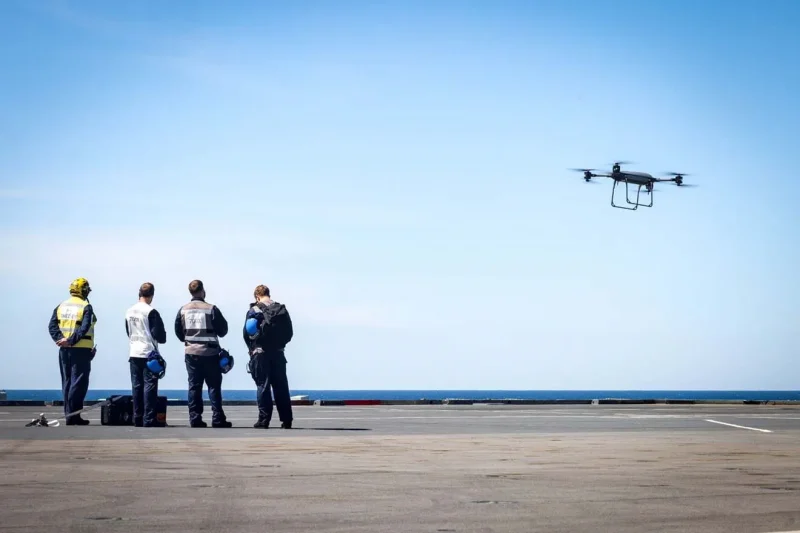
Royal Navy uses UASs for delivery between ships
The Royal Navy has made a delivery of supplies between warships using a Malloy T-150 quadcopter Uncrewed Aerial System (UAS) during its major 2025 Indo-Pacific mission.
The UAS flew from flagship HMS Prince of Wales to destroyer HMS Dauntless during the UK Carrier Strike Group deployment carrying critical supplies, including spare and repair parts. The Malloy UAS is an eight-bladed system operated by a crew of two. It is able to carry up to 68kg and fly up to 60mph (96 km/h) and is operated on this mission by 700X Naval Air Squadron. Malloy is a subsidiary of BAE Systems.
The UAS was flown autonomously during take off and for just over a mile during the sortie itself, and was subsequently controlled by crews on HMS Dauntless to guide it onto the ship’s flight deck and make a safe landing.
The aim of the trial was to provide a cheap and efficient alternative to using helicopters or boat transfer to make deliveries and free them up to focus on operational tasks, says the Royal Navy. It comes as the service seeks to equip its Queen Elizabeth-class carriers with hybrid air wings, including fast jets, long-range weapons and a range of advanced UASs and deliver on its plans set out in the UK’s Strategic Defence Review, the RN adds.
“The Royal Navy is leading the way in shaping the future of Hybrid Air Wings, with the impressive progress showcased during Carrier Strike Group 25,” said Luke Pollard, Minister for the Armed Forces. “Embracing autonomy is pivotal to the way we will operate in the future, and this achievement stands as a powerful example of our armed forces working seamlessly alongside British industry to deliver cutting-edge innovation and capability at sea.”
The Royal Australian Navy is believed to have been the first to actually prove the principle of stores delivery by using a maritime UAS to deliver stores between two warships under way during an exercise last year, but the Royal Navy claims to have been the first to achieve this milestone as part of a regular deployment of ships and an aircraft carrier.
“This milestone in the Malloy trials is a step toward the vision of a fully integrated hybrid carrier air wing,” said Captain Colin McGannity, Commander Air Group, UK Carrier Strike Group. “By taking some of the logistics burden, Malloy will allow our naval helicopters to concentrate on their core outputs, while delivering, rapid, more efficient resupply across the whole Strike Group.
“The really exciting bit is that we then plan to incorporate these lessons to be able to use UAVs for many other roles, including options for warfighting.”
The UASs currently deployed on Operation Highmast – the name of the UK Carrier Strike Group’s eight-month deployment to the Indo-Pacific – have carried out nearly 150 deck landings and flown more than 20 hours of sorties, said the RN.
The T-150 UAS is made by British company Malloy Aeronautics, which has been owned by BAE Systems since February 2024, and produces a variety of UASs designed for civilian and military purposes, says the RN.
Related Posts