The Australian Defence Force and Japanese Self-Defense Force have successfully trialled a High Energy Laser…

MQ-9B gets Saab AEW capability and GA-ASI announces new autonomous launched effect
San Diego-based General Atomics Aeronautical Systems, Inc. (GA-ASI) announced at the Paris Air Show it is partnering with Swedish company Saab to develop an Airborne Early Warning and Control (AEW&C) capability for its MQ-9B Uncrewed Aircraft System (UAS), which includes the SkyGuardian® and SeaGuardian® models, the United Kingdom’s Protector, and the new MQ-9B STOL (Short Takeoff and Landing) model currently in development. GA-ASI plans to fly an AEW sensor on an MQ-9B in 2026.
“High and low-tech air threats both pose major challenges to global air forces,” said David R. Alexander, GA-ASI’s President. “We’re developing an affordable AEW solution in cooperation with Saab, the leading provider of AEW&C systems, that will transform our customers’ operations against both sophisticated cruise missiles and simple but dangerous drone swarms.
“We’re also making AEW capability possible in areas it doesn’t exist today, such as from some navy warships at sea,” he added.
GA-ASI will pair Saab’s AEW sensors with what the company says is the world’s longest-range, highest-endurance UAS. The MQ-9B AEW solution, says the company, will offer critical aloft sensing to defend against tactical air, guided missiles, drones, and other threats at a fraction of the cost of manned platforms. AEW for MQ-9B will also give air forces that need AEW but lack legacy platforms an affordable means to counter threats.
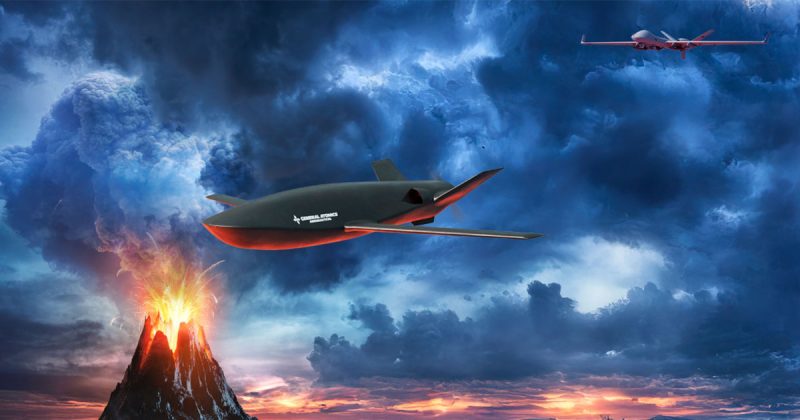
The company also unveiled at the Paris Asir Show a new small uncrewed launched effect with widespread multi-mission capabilities which can be launched, at least initially, from the MQ-9B.
Inspired by Pele, the Hawaiian goddess of powerful natural forces in the Pacific, the Precision Exportable Launched Effect – PELE – is a small, attrition-tolerant, propeller-driven UAS designed to extend the sensing and other capabilities of a mothership aircraft. The semi-autonomous PELE is 9ft long, has a maximum gross takeoff weight of 250lbs, 7 hours endurance and range of 500nm, says the company. It can also be launched from the ground.
The new PELE is optimized for use on the MQ-9B SkyGuardian, says GA-ASI; this UAS is in use or being considered for use by a growing number of nations around the world. PELE can fly with an onboard electro-optical infrared sensor for full-motion video as well as other integral sensors. The aircraft also has internal stowage for its own mission payloads.
“PELE brings even more versatility to growing MQ-9B fleets around the world,” said GA-ASI President David R. Alexander. “On one day, an air force might fly an MQ-9B with no external payloads to maximize its patrol time. Then on the next day, the same aircraft could take off and fly with several PELEs that would stand in against the adversary and take the immediate risks to preserve the larger aircraft.”
For example, MQ-9B might approach a contested boundary from international waters and release PELE to scout through the disputed zone to assess a hostile force’s order of battle or detect and precisely geo-locate anti-air systems. However, the company hasn’t detailed as yet whether or not PELE can be recovered or is more like a one-way loitering munition.
Related Posts