The US Navy has disclosed it is developing the Air Intercept Missile (AIM)-424 Malice Long…
MBDA unveils One Way Effector to saturate enemies’ defences
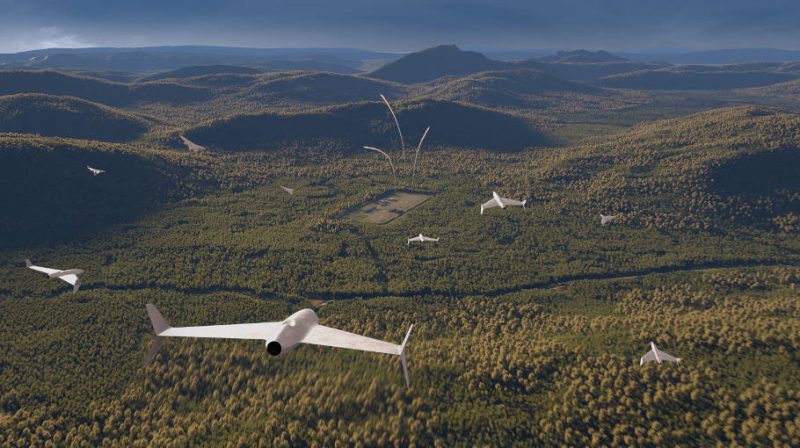
European missile house MBDA has unveiled its One Way Effector (OWE), a long-range loitering munition able to be manufactured at scale. It is being developed in partnership with a drone manufacturer and other industry players, notably from the automotive sector, though the company has not named its partners.
Designed to adapt to armed forces’ need to deploy mass in a high-intensity context, the OWE is a long range strike drone that can be produced in mass at lower cost, through an innovative production setup, says MBDA. Production rates under this new business model could be up to 1,000 a month.
This new effector allows the armed forces to have a sovereign long-range strike capability in the 500km class to saturate enemy defences. Easy to use through a simple mission-planning tool with on-coordinate strikes, the OWE includes an autonomous flight capacity coupled with the possibility to fire in coordinated salvo in order to strike en masse, permitting a stand-off saturation capability that is sustainable in the long term, throughout the conflict.
One Way Effector represents a trade-off between the need for mass and performance at lower cost to meet the challenges faced by armed forces in a high-intensity context, says MBDA. It is a new attrition proposition based on feedback from the armed forces, informed by the conflict in Ukraine.
Fired from the ground in salvoes, the OWE is aimed at exhausting enemy resources by exerting constant pressure on hostile air defence systems, with a warhead large enough to compel the enemy’s defences to destroy it, the company adds. In so doing, the new effector is intended to force even the most sophisticated air defences to reveal themselves, making them easier to detect and neutralise, in conjunction with other long-range strike systems.
The OWE combines MBDA’s expertise in cruise missiles and remote-controlled munitions, but also benefits from new drone technologies and from civilian industry’s production capabilities.
Experience drawn from recent and current air force operations has revealed that conflicts no longer follow predictable phases and targeting is no longer a static, the company comments, but a highly dynamic process.
Related Posts