The US Air Force Research Laboratory (AFRL) and Anduril Industries have demonstrated modularity on a…
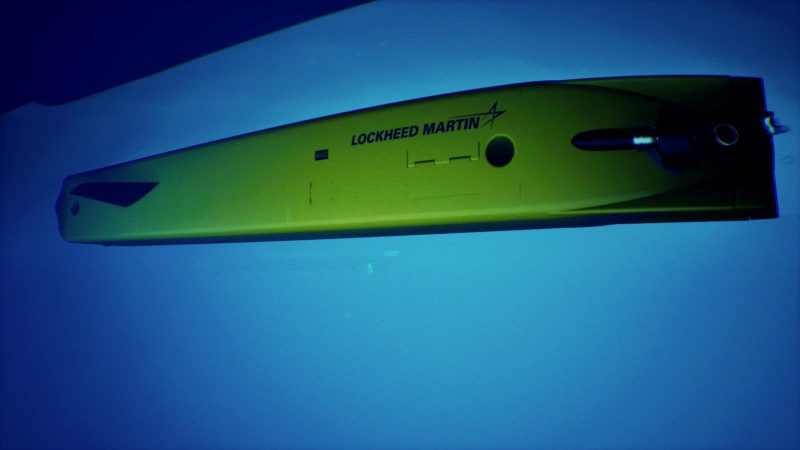
Lockheed Martin unveils Lamprey MMAUV
US defence contractor Lockheed Martin has unveiled its new Lamprey Multi‑Mission Autonomous Undersea Vehicle (MMAUV), which the company describes as a breakthrough “plug-and‑play” submersible designed to give US and allied war fighters technological and strategic advantage in today’s contested maritime arena.
The Lamprey MMAUV was designed to satisfy the US Navy’s need for covert, assured access and to carry out sea denial operations. However it wasn’t designed with a specific US Navy project in mind – Lockheed Martin states that it showcases advancements leveraging the company’s internal R&D funding, rather than anything specifically customer-funded.
“The modern battlespace demands platforms that hide, adapt and dominate,” said Paul Lemmo, vice president and general manager of Sensors, Effectors & Mission Systems at Lockheed Martin. “Lamprey MMAUV was internally funded, letting us iterate at lightning speed and hand the Navy a true multi-mission weapon that detects, disrupts, decoys and engages on its own.”
Designed to disrupt and deny enemy forces at sea, the Lamprey MMAUV has proved its autonomous manoeuvre and surveillance capabilities in at-sea exercises and tests, Lockheed Martin says. Its open architecture design and 24 cubic foot payload bay can accommodate a wide range of customizable mission payloads for subsea seabed warfare. It can carry Uncrewed Aerial Systems (UAS) for surveillance or strike, and can also carry torpedoes and other payloads.
It can attach itself to the hull of a host surface vessel or submarine using suction technology rather than magnetics, and use hydrogenators (similar to the ram-air turbines used by aircraft) to charge its batteries and arrive in theatre ready for operational missions. The Lamprey MMAUV can perform a wide range of missions, the company says, including delivering undersea and air kinetic and non-kinetic effects; performing Intelligence, Surveillance and Reconnaissance (ISR), targeting, multi-intelligence collection, and deploying equipment to the seafloor.
While the Lamprey MMAUV is fully autonomous, the company adds, it can have an operator on the loop for particular missions. It demonstrated during a recent military exercise that while submerged it could autonomously acquire, track, and trail a target vessel undetected and then provide information via satellite communications.
The Lamprey MMAUV slightly resembles both the much larger Anduril Industries Ghost Shark submersible and Copperhead torpedo-like family of payloads. However, it is not designed to be fired from a heavyweight torpedo tube on a submarine. Lockheed Martin has also not disclosed the length and cross-sectional dimensions of the square section Lamprey MMAUV, nor details of its speed and maximum depth. Video shows it pre-deploying, sitting on the seabed awaiting friendly forces and then attaching to the underside of a friendly warship or submarine.
Lockheed Martin’s media release makes clear the US Navy is one of its sales targets and the key innovations that put the Navy ahead, it says, are:
- Novel Range and Placement – imitating nature, the vehicle attaches onto a host surface ship or submarine with no host modifications needed; once attached it recharges batteries with built‑in hydrogenators
- Deployable Payload-Centric Design – From anti‑submarine torpedoes to UAV launchers, the open‑architecture payload bay lets customers tailor the vehicle to any mission set
- Dual‑Mode Mission Set – the Lamprey MMAUV can carry out both Assured Access (stealthy intelligence gathering, persistent surveillance, precision strike) and Sea Denial (electronic disruption, decoy deployment, kinetic attack), giving commanders a single platform that flips the maritime balance of power
By providing a persistent, autonomous undersea presence at dramatically lower cost than manned platforms, the Lamprey MMAUV can deny areas and control the seabed, says Lockheed Martin.
Related Posts