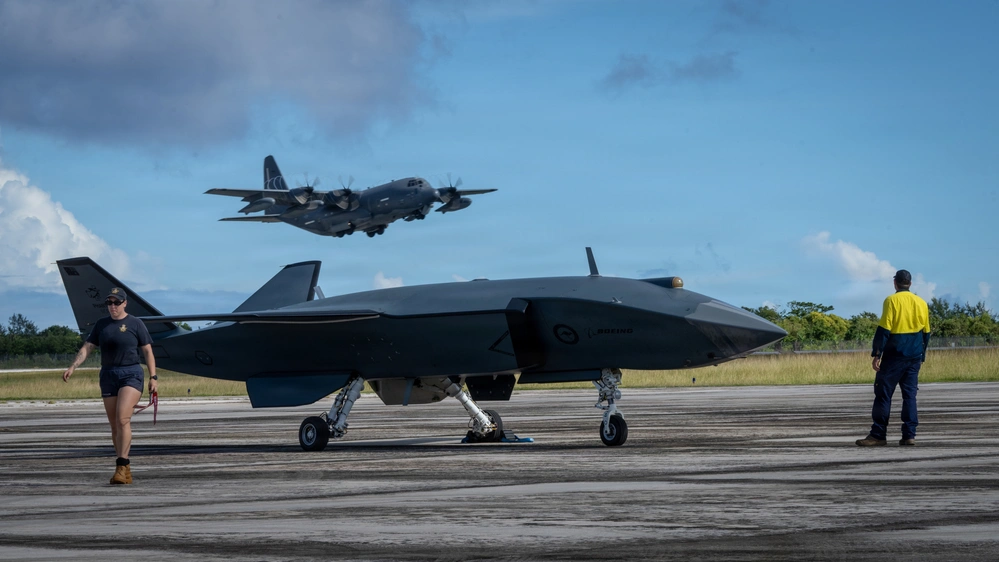
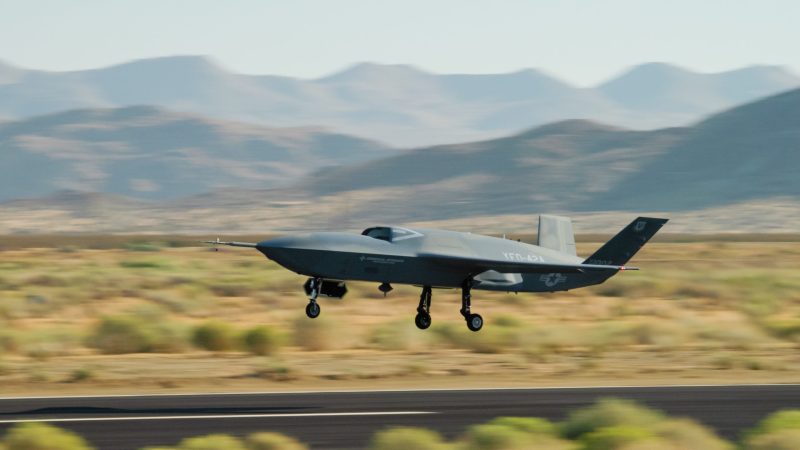
The Boeing Defence Australia-developed MQ-28A Ghost Bat Collaborative Combat Aircraft (CCA) will integrate with US…

Lockheed Martin to quadruple PrSM manufacture
Lockheed Martin and the US Department of War (DoW) have announced a framework agreement to accelerate the production of Precision Strike Missiles (PrSM).
The agreement builds on a previous US$4.94 billion ($7.1 billion) contract award from the US Army last year and, together, these agreements will quadruple PrSM production capacity. The company has declined to say how many PrSM missiles it will manufacture each year; and no contracts for new missiles have been awarded as yet.
The agreement is a direct outcome of US Secretary of Defense Pete Hegseth’s mandate to move faster, put America’s defence industrial base on a wartime footing, and build the Arsenal of Freedom, says the DoW. It also establishes the potential to negotiate a multi-year contract for up to seven years, should Congress authorize a multi-year contract in the future, the Department adds.
On 4 March US Central Command confirmed that PrSM was used in combat for the first time during Operation Epic Fury, the US campaign against Iran, marking the system’s operational debut and demonstrating expanded deep-strike capability.
Designed to succeed the legacy Army Tactical Missile System (ATACMS) and fired from the same wheeled M142 High Mobility Artillery Rocket System (HiMARS) launchers, PrSM delivers extended range – at least 500km versus a reported 300km – improved lethality and platform versatility, according to a Lockheed Martin media release.
In 2025, the Australian Government signed a Memorandum of Understanding (MoU) with the US for production, sustainment and follow-on co-development of the PrSM, including Increment 2, which will have a moving target seeker. The Australian Government is contributing US$310 million ($446 million) over 10 years to become a full cooperative partner in the PrSM program, with more than $150 million ($216 million) over the next five years to acquire the initial quantities of missiles required for the Australian Army’s Long Range Fires Regiment, 14 Regiment.
This MoU accelerates Australia’s long-range, land-based strike capabilities and establishes PrSM as a cooperative program between Australia and the United States.
Last December Lockheed Martin announced the assembly of Guided Multiple Launch Rocket System (GMLRS) projectiles for the Royal Australian Artillery at an all-new facility at Port Wakefield, SA. But the company is believed to be looking also for a new and larger facility where it can manufacture both the GMLRS and PrSM in Australia.
Lockheed Martin’s contract with the US Department of Defense is expected to open the door for Australian industry participation in the PrSM supply chain, including locally manufactured components and sub-components.
Earlier this month Lockheed Martin and the US Army completed the first flight‑test of PrSM Increment 2.
“This … serves as a testament to the success of the cooperative partnership between the Australian and US governments in accelerating the production and development of the Precision Strike Missile,” said Jeremy King, Chief Executive of Lockheed Martin Australia and New Zealand. “Lockheed Martin’s close collaboration with the US Army and our supplier network aims to enhance long‑range, land‑based strike capabilities in Australia and to ensure a more secure Indo‑Pacific region.”
Lockheed Martin is also one of two preferred options to satisfy the Australian Army needs under Project LAND8113 Ph2, a second Long-Range Fires Regiment to be used in the Land-Based Maritime Strike (LBMS) role; the company is offering PrSM Increment 2 with an additional tranche of HiMARS launch vehicles. The other contender is Kongsberg which is building the Naval Strike Missile (NSM) in Australia with the first missile due to come off the line, adjacent to RAAF Base Williamtown, in 2027. A choice between the two is expected in the coming months.
Earlier this month the company disclosed it is collaborating with Rheinmetall Defence Australia on possible sustainment of the HiMARS vehicle in Queensland and South Australia.
Related Posts