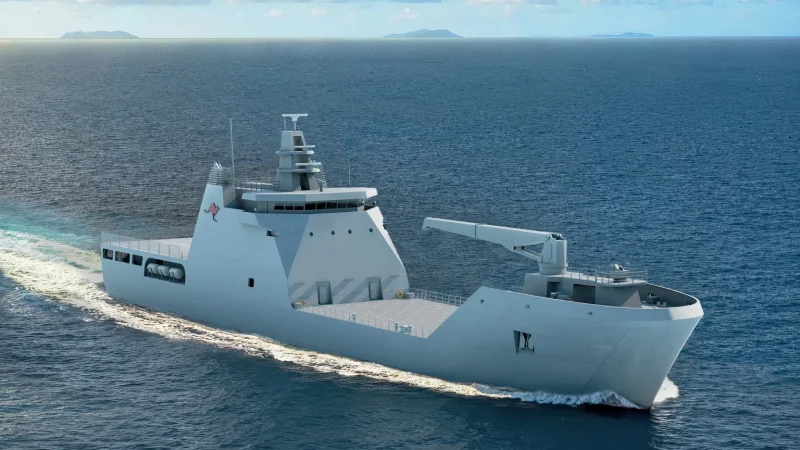
Defence has awarded Austal Defence Shipbuilding Australia Pty Ltd (Austal Defence Australia) a $4 billion…

DARPA takes X-68A toward CCA-like goal
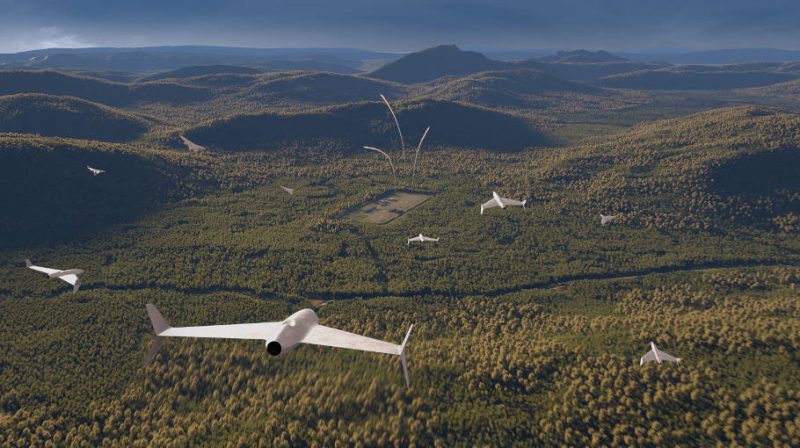
The US Defense Advanced Research Projects Agency’s (DARPA) LongShot program has successfully completed a series of technical milestones, moving its air-launched uninhabited vehicle – recently designated the X-68A – closer to flight testing, says DARPA in a media release. The X-68A is similar in concept to the Collaborative Combat Aircraft (CCA) program in which the General Atomics Aeronautical Systems Inc (GA-ASI) YFQ-42A and Anduril Industries YFQ-44A Fury are under development for the US Air Force.
Recent achievements, including full-scale wind tunnel tests and successful trials of the vehicle’s parachute recovery and weapons-release systems, demonstrate significant progress in developing this next-generation capability.
The LongShot program is designed to fundamentally change air combat operations. GA-ASI is the industry lead responsible for designing, building and demonstrating the LongShot concept.
The program’s premise is an uninhabited aircraft that can be launched from a larger aircraft, fly ahead of follow-on forces, and engage enemy targets with its own air-to-air missiles, according to DARPA. This approach augments traditional fighter aircraft, enabling them to remain farther from the front lines, drastically increasing pilot safety while extending the overall force package reach and mission effectiveness. The X-68A differs from the USAF’s CCA program in being air-launched – the CCAs currently under development take-off and land conventionally – which means it is probably significantly smaller than a CCA. DARPA has not disclosed the weight and dimensions of the X-68A.
The LongShot concept is intended to be host-platform agnostic, providing opportunities to integrate an operational variant onto fighters, bombers, or employed as a palletized munition from mobility aircraft, says DARPA.
“LongShot burns down significant technical risk and presents a viable path for the military services to increase air combat reach and effectiveness from uninhabited, air-launched platforms,” said Colonel John Casey, DARPA’s LongShot program manager. “With the help of our partners, we’ve completed critical milestones necessary for the integrated flight test campaign, which will validate vehicle performance and lay the foundation for efficient follow-on development.”
The program leverages expertise from a multitude of US government stakeholders, including:
- The United States Air Force’s (USAF’s) Arnold Engineering Development Complex
- USAF’s Life Cycle Management Center
- USAF’s F-15 Program Office
- USAF’s 96th Test Wing
- Air Force Research Laboratory
- Naval Air Warfare Center Aircraft Division
- National Aeronautics and Space Administration
- US Army Engineer Research and Development Center
- Aviation & Missile Center within the U.S. Army Combat Capabilities Development Command
- US Army’s Redstone Test Center within the U.S Army Test and Evaluation Command
- US Army’s Yuma Proving Grounds
With ground and integration testing currently underway, the program is building toward a flight test campaign as early as the end of 2026. These tests will prove the safe and effective employment of the X-68A from an F-15, confirm the flight worthiness of the LongShot vehicle, and demonstrate its ability to safely eject a captive sub-munition.
Related Posts